Belderrig
Belderrig, Co. Mayo in the West of Ireland
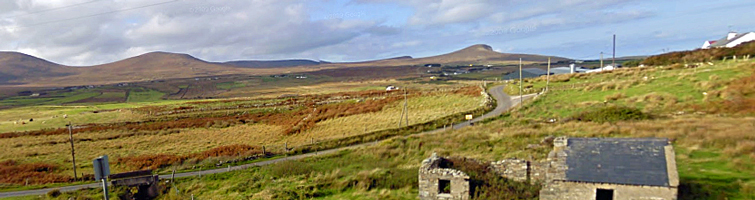
Belderrig is a scenic coastal village straddling the Atlantic Ocean between Ballycastle and Belmullet in North Mayo. In Irish 'Béal Dearg' - the red mouth - comes from the red colour of the water at the river mouth at certain times of the year. The Belderrig river catchment area has rich deposits of iron ore mixed with clay, resulting in red ore (or 'ridge bhui' as it is known locally) being released towards the river mouth when old drains are opened in Spring.
The visitor will find little else in Ireland to surpass the wild, cragged scenery at Belderrig. Once in Belderrig you forget traffic, haste, stress, depression. A trip to Belderrig is like travelling back in time, watching the turfcutter harvest his winter fuel on ancient bogland or the fisherman in his traditional 'currach' take home his evening catch into the shelter of the bay. Belderrig is probably the centre of the North Mayo currach region and one can usually see a number of these vessels anchored in the bay at Belderrig. A history book written by Dr Breandán Mac Conamhna - 'The Belderrig Curragh and Its People' is a book about this unique seagoing craft.
The Belderrig coastal area, in its rugged simplicity, is a sanctuary for the geologist or the botanist, offering magnificent scenery of sea and cliffscapes and dramatic mountains. In immediate proximity to the village are the Belderrig Cliffs, from which the visitor has fine views as far as Porturlin and Portacloy to the north west. The Stags of Broadhaven rise majestically in the distance and one can see the Sligo coastline and the cliffs of Killybegs and Teelin (Donegal) on a clear day.
You will be impressed by the full moon in Belderrig, but equally by the spectacular stars on a moonless night, undisturbed by background lights of towns. Whether storms bring the Atlantic to boil or the flat waters at a quiet summer evening, nature's power can be felt in Belderrig.
Archaeology
Belderrig is a rural area located in a region rich in historical and archaeological heritage. There is plenty of archaeological evidence to show that Stone-Age farmers lived in Belderrig and the first Stone-Age plough marks ever found in Ireland were uncovered beneath the bog there.
In the 1930s, whilst cutting turf each year, the local schoolmaster, Patrick Caulfield, continued to find large numbers of stones deep down in the bog. He was particularly intrigued by the fact that they appeared in a regular formation and the depth at which the stones were found suggested they must have been placed there centuries ago. Years later, his son, Professor Seamus Caulfield, an archaeologist, discovered evidence of cultivated fields, houses and tombs, at what is now known as Céide Fields. This unique landscape had lain hidden for many centuries.
The poet and Nobel Prize recipient Seamus Heaney wrote a poem called "Belderg" which he enclosed in a thank-you letter to Patrick Caulfield, after he had visited him in Belderrig in 1974. This poem effectively captures the essence of the pre-historic Belderrig landscape.
Nearest towns
Ballycastle 15km Killala 29km Belmullet 32km Ballina 41km
"Belderg" - by Seamus Heaney
The essence of the Belderrig ('Belderg') landscape was captured by Seamus Heaney in a poem accompanying a thank-you letter shortly after a visit to Patrick Caulfield's house in 1974.
And were thought of as foreign'-
One-eyed and benign
They lie about his house,
Quernstones out of a bog.
To lift the lid of the peat
And find this pupil dreaming
Of neolithic wheat!
When he stripped off blanket bog
The soft-piles centuries
Fell open like a glib:
There were the first plough-marks,
The stone age fields, the tomb
Corbelled, turfed and chambered,
Floored with dry turf-coomb.
A landscape fossilized,
Its stone wall patterings
Repeated before our eyes
In the stone walls of Mayo
Before I turn to go
He talked about persistance,
A congurence of lives,
How, stubbed and cleared of stones,
His home accrued growth rings
Of Iron, flint and bronze.
So I talked of Mossbawn,
A bogland name. 'But Moss?'
He crossed my old home's music
With older strains of Norse.
I'd told how its foundation
Was mutable as sound
And how I could derive
A forked root from that ground
And make bawn an English fort,
A planter's walled-in mound
From "Belderg" by Seamus Heaney 1975